
Why do people with ADHD struggle with relationships?
Relationships have a way of shining a light on the places where we feel most vulnerable. For many people with ADHD, that light can feel more like a spotlight: bright, hot, and a little too revealing. Not because they don’t love deeply or care fiercely, but because the world wasn’t exactly designed with their brain in mind. When you add another human with their own expectations, habits, and assumptions into the mix, even small misunderstandings can snowball into “Why is this happening again?” moments.
During a recent interview, Grazel Garcia, founder of Grazel Garcia Psychotherapy & Associates shared how often ADHD traits are interpreted as character flaws rather than neurological differences. The gap between intention and execution can be wide, especially when the brain is bouncing between a dozen thoughts before breakfast. And when that difference shows up inside a relationship (where timing, communication, and emotional presence matter) things can feel shaky quickly.
But here’s the good news: none of this means an ADHD relationship is doomed, broken, or destined to repeat the patterns of the past. The struggles couples face aren’t moral failings; they’re mismatched operating systems. One partner is running iOS, the other Android, and neither came with a charger!
This article digs into why people with ADHD often struggle in relationships, what’s actually happening beneath the surface, and how couples can move their interactions from prickly friction to compassionate understanding. Everything here is grounded in Grazel’s clinical experience and the wisdom she shared, plus a few evidence-based stats to help make sense of it all.
Watch the full interview here!
The Time Blindness Trap
If there’s one pattern that shows up again and again in ADHD-affected relationships, it’s the tension that comes from mismatched time perception. Most partners don’t realize they’re living in two completely different timelines until the conflict is already simmering. One person thinks, “You said you’d do it in half an hour,” and the other is thinking, “Half an hour? I swear it felt like half an hour….”
“Someone who is neurodivergent may think, ‘Yeah, I can finish that in 30 minutes,’ but it can take them an actual hour because of how busy their brain gets.”
This isn’t laziness, and it’s not manipulation. It’s not even forgetfulness in the traditional sense. It’s rooted in executive functioning: specifically the way the ADHD brain tracks (or doesn’t track) the passing of time. Researchers have found that adults with ADHD are three times more likely to struggle with time management because of executive functioning challenges. That means it’s a neurological difference, not a character flaw.

But even in a healthy relationship, neurological nuance often gets lost under emotional impact. When someone with ADHD says, “I’ll do it in 30 minutes,” they usually mean it. They genuinely believe it. Then a distraction hits – the email, the thought, the noise outside, the sudden memory that something else needs attention – and the entire plan gets derailed. Meanwhile, their partner is watching the clock and watching their patience evaporate.
And this is where the hurt begins. A missed task becomes a broken promise. A delay becomes, “You don’t care.” The reality is simply that two people can experience time very differently.
When couples are trying to figure out these patterns here in the city, many find that ADHD therapy in LA gives them a shared language for this difference. Once partners understand that time blindness is neurological, not personal, communication softens, expectations shift and the relationship steadies.
If time feels like a constant battleground in your relationship, it may help to slow things down… literally. Creating shared timelines, external reminders, or pause-and-check-in moments can take some of the pressure off both of you and create more room for understanding.
Need some help to slow things down?
The Follow-Through Misunderstanding
If time blindness creates the spark, lack of follow-through is often what fans the flames. In many couples, whether neurodivergent or not, this becomes one of the most painful sticking points, because it doesn’t just touch the task itself. It touches something deeper. For the non-ADHD partner, it can sound like, “You promised.” For the ADHD partner, it sounds like, “I really thought I could.”
Follow-through difficulties are one of the most common ADHD traits, and they show up everywhere: unfinished chores, half-started projects, forgotten errands, misplaced items that were just in their hand two seconds ago. The intention is there, it’s just that the brain’s cooperation is not always guaranteed.
“You’re saying something, but you’re not following through on what you said, so that can double down on the personalization of the other partner.”
And she’s right, because when intention and outcome don’t match, partners often interpret the gap emotionally. But research shows that up to 75% of adults with ADHD report chronic difficulties completing tasks across multiple areas of life. So this isn’t about effort; it’s about neurological load.
Inside relationships, this mismatch can loop into a painful pattern:
- The ADHD partner genuinely plans to do the thing.
- Their brain pulls them off course.
- The non-ADHD partner sees inconsistency as indifference.
- The ADHD partner hears disappointment as rejection.
- Everyone loses.
When neurodivergent people begin to explore this dynamic through therapy for neurodivergent folx, something shifts. Accountability stops being a source of shame and becomes a shared system: external reminders, written agreements, or check-ins that support both partners instead of judging one.
If follow-through has become a sensitive topic between you and your partner, try focusing less on “Why didn’t you?” and more on “What support would help next time?” A small reframing goes a long way in lowering defensiveness and building trust.
Need some help to know what to say?
“You Don’t Understand Me”
There’s a particular deep-chested ache that shows up for many people with ADHD: an old, familiar sense of being misunderstood. It’s not just about the dishes or the messages left on read. It’s deeper. More existential. A lifetime of “Why are you like this?” can settle into the bones long before a partner enters the picture.
From childhood onward, many neurodivergent people absorb messages that the “right” way to think, behave, or focus is the neurotypical way. The world teaches them (both silently and loudly) that success looks linear, tidy, and predictable. So when their mind works in spirals, in bursts, in brilliant-but-chaotic threads, they’re taught to see it as ‘wrong’. Or less than. Or defective.
“Part of their experience… societally, there’s a lot of messages that you have to think a certain way in order to make it work in this life and be successful. So if you diverge from that societal expectation… you’re ‘less than.’”
That messaging doesn’t disappear in adulthood. Instead, it shows up in relationships, especially when communication gets strained. Even when a partner fully understands ADHD on paper, the neurodivergent person may still feel unseen because the internal shame comes from much earlier, much deeper.
And emotional paralysis plays a role too. When someone with ADHD becomes overwhelmed, their brain doesn’t always give them access to language in the moment. Words jam. Explanations freeze. Responses stall. What their partner sees as distance or avoidance is often just neurological overload.

Around 34% of adults with ADHD experience emotional dysregulation intense enough to significantly impact communication and relationships. So misunderstandings can stack on top of older misunderstandings. A missed cue becomes proof. A delayed response becomes silence. The ADHD partner feels unheard, even when they’re trying. The non-ADHD partner feels confused, even when they’re patient.
This is where many couples find that couples therapy in LA becomes less about “fixing problems” and more about building a shared language: one that honors the ADHD partner’s internal world, not just their external behavior.
If you or your partner often feel misunderstood mid-conversation, it can help to slow things down. Pauses, breath resets, or even saying “I need a moment to find my words” can soften the whole dynamic and create space for clarity instead of conflict.
At GGPA, we equip ADHD-affected couples with the tools and techniques to reset the relationship’s dynamic.
The Personalization Loop
Another common pattern that can send an ADHD–non-ADHD relationship spinning in circles, it’s personalization. Both partners experience it, but in very different wayd, and both end up feeling hurt.
For the non-ADHD partner, personalization often sounds like:
- “If you loved me, you’d remember.”
- “If you cared, you’d follow through.”
- “You said you’d do it, so why didn’t you?”
From the inside, those reactions make sense. When behaviors feel inconsistent, the brain looks for explanations, and the quickest explanation is usually personal. But what starts as a practical frustration can build into a painful and even resentment-building belief over time: “Your ADHD traits mean I don’t matter.”
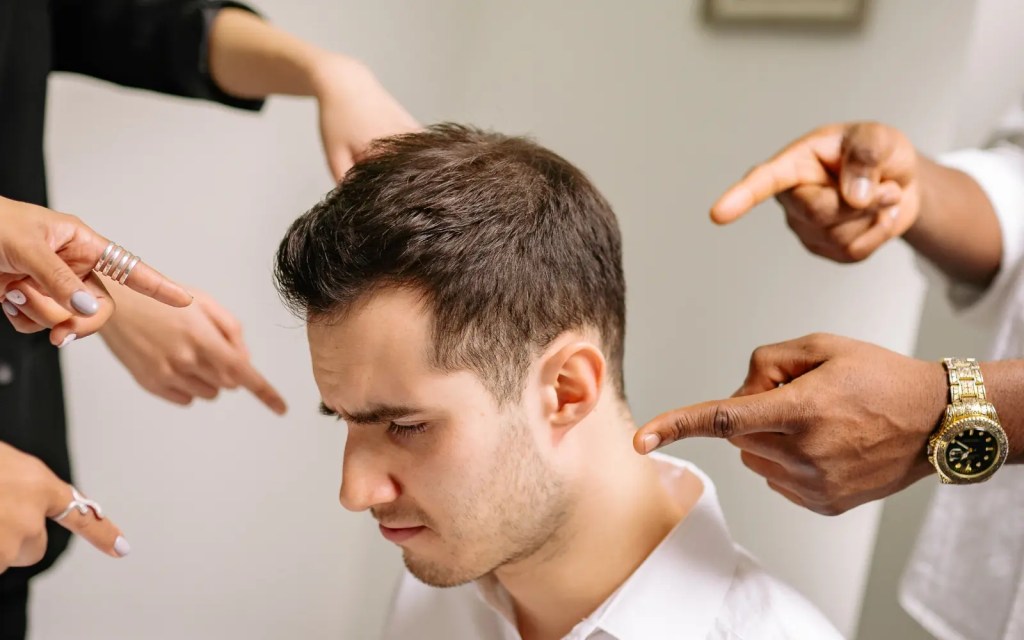
On the other side, the ADHD partner is having a very different experience, one that’s often invisible unless someone knows to look for it. Long before anyone else expresses disappointment, they’ve already delivered a harsher version to themselves. The self-criticism is relentless. If anything, the partner’s frustration just confirms what they already fear: “I’m failing again.”
“The person with ADHD is the biggest critic of themselves… they feel inferior to others, and that’s not their fault.”
And the research on this is almost unbelievable. Up to 99% of adults with ADHD report symptoms consistent with Rejection Sensitive Dysphoria: an intense fear of being a burden, letting others down, or being rejected. This means their emotional system is already primed to interpret conflict as confirmation of inadequacy.
The result?
- Two people, both feeling unheard.
- Two interpretations, both rooted in fear rather than intention.
- Two nervous systems reacting to the same moment in completely different ways.
This is one of the places where ADHD therapy in LA can be transformative. When couples learn to separate the symptoms from the internal narrative, personalization loses its power. Partners begin to see each other’s reactions as protective, not punitive.
If you find yourselves stuck in this loop, try shifting from “You did this to me” to “What happened for you in that moment?” That single question can open the door to empathy instead of escalation.
GGPA specializes in breaking the negative cycle to bring you closer. Book a free consultation to discover how we can help.
Masking and the False Self
Masking is one of those experiences most ADHD partners know intimately, even if they’ve never had a name for it. It’s the subtle (or not-so-subtle) act of tucking away the parts of yourself that feel “too much,” “too messy,” or “too different” to be accepted. And while masking might help someone get through school, work, or social settings, it becomes emotionally expensive inside a relationship.

Many people with ADHD learn early on that the world rewards “looking put together,” even if it takes three times the effort to hold that pose. Over time, that masked version of themselves becomes a kind of armor — polished, competent, agreeable. The problem is that armor gets to feel heavy after a while, and at some point the real self starts slipping through the cracks.
“The more you mask, the more you play this false sense of self… and when you do show your true self, your partner may feel confused.”
Confusion is almost inevitable. A partner might think, “You’ve changed,” when in reality, they’re simply seeing the unmasked version for the first time. For the ADHD partner, that moment can feel frightening. Vulnerable. Shame-filled. They fear losing acceptance right at the moment they’re finally being authentic.
Studies show that around 70% of neurodivergent adults mask daily as a way to cope with external expectations. Over time, masking can contribute to burnout, depression, and a painful disconnect from one’s identity.
This is why so many couples find immense relief when they begin exploring this pattern through ADHD therapy in LA. Therapy creates a space where authenticity isn’t just allowed. It’s supported. Partners learn what masking looks like, how to recognize it in real time, and how to respond in a way that doesn’t trigger shame.
If you’ve been hiding parts of yourself to “keep the peace,” consider choosing one small, honest moment this week to show up as you are. Authenticity doesn’t have to happen all at once — it grows in small, safe doses.
Healing Together
By the time most couples reach therapy, they’ve usually tried to fix the same arguments in a dozen different ways. They’ve read articles, swapped strategies, made chore charts, set alarms, downloaded apps, and promised themselves that this time will be different. And still, the patterns sneak back in. Not because anyone is broken, but because ADHD requires a different kind of support than willpower or good intentions alone.
“You can use medication to help stabilize, but it doesn’t really teach you skills.”
That distinction matters. Medication can make everyday functioning smoother, but it can’t replace learning how to communicate during overwhelm, or how to co-create routines that help both partners feel more supported. That’s where therapy comes in, not to “correct” ADHD traits, but to help partners understand them, work with them, and feel less alone inside them.
Research shows that combining behavioral therapy with medication can improve daily functioning by up to 70%. But even without medication, specialized therapy itself can change the entire emotional climate of a relationship. Couples start to see patterns earlier. They interrupt conflicts more gently. They build shared systems that reduce shame instead of fueling it.
For couples here in the city, ADHD therapy in LA often looks like:
- learning communication tools that work with ADHD processing speeds
- unpacking personalisation loops and rejection sensitivity
- understanding emotional paralysis
- building routines that reduce overwhelm rather than increase pressurz
- supporting both partners’ nervous systems, not just the ADHD partner’s
And perhaps most importantly, therapy gives couples a place where neurodivergence isn’t treated as a flaw, it’s treated as a context; a way of understanding behavior, not blaming it.
If you and your partner feel stuck between good intentions and hard patterns, consider exploring support together. Sometimes the smallest change in approach can open doors that felt shut for years.
Final Thoughts
ADHD doesn’t break relationships, but the misunderstandings around it can certainly shake them. Most ADHD-affected couples struggle because they’re speaking two different emotional languages without realizing it. One partner is trying their best while battling executive function hurdles the other can’t see. The other is doing their best while trying to make sense of behaviors that don’t line up with intention. Somewhere in the middle, both end up feeling hurt, and over time the tension and resentment can build.
But what Grazel believes is something many couples need to hear: these patterns aren’t personal. They’re not proof of failure or incompatibility. They’re the predictable friction of a neurodivergent brain trying to operate in a world, and a relationship, built around neurotypical norms.
The more couples understand this, the more compassion enters the room. Time blindness becomes less of a betrayal. Follow-through becomes less of a moral issue. Emotional paralysis becomes a cue for patience instead of frustration. And masking becomes something neither partner needs for safety.
With the right support, partners can learn to see each other more clearly and work together instead of against each other. Understanding the “why” behind the struggle is often the first step toward building something steadier, kinder, and far more connected.
Grazel Garcia Psychotherapy & Associates is one of the leading individual and couples therapy practices in the wider Los Angeles area. Specializing in treating root causes through the lens of EFT, GGPA clients can expect a warm, culturally-attuned approach to therapy. Call 323-487-9003 and schedule your free consultation today!