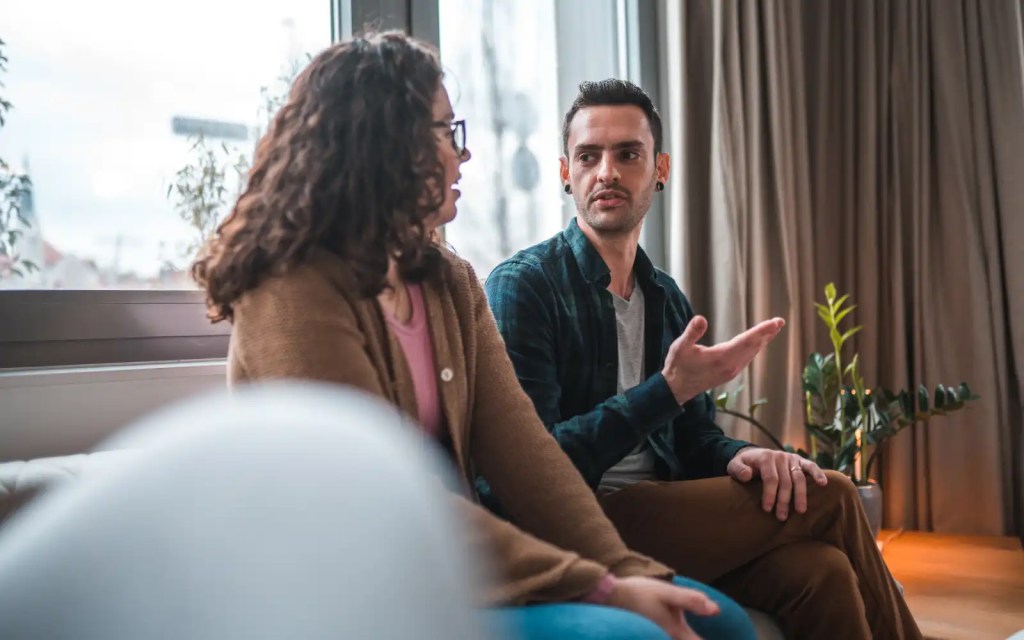

How do people with ADHD treat their partners?
Being in a relationship where one partner has ADHD can feel a bit like reading a book with missing pages: you know the story is good, you just can’t always follow the jumps. One moment there’s warmth, creativity, and connection, and the next there’s distraction, forgotten plans, or an emotional reaction that feels bigger than the moment. Many couples come to ADHD couples therapy long after they’ve spent years personalizing behaviors that were never personal in the first place.
This article is here to help you make sense of it all.
- Understanding ADHD Traits in Relationships
- When Inattentiveness Looks Like Disinterest
- Hyperactivity & Emotional Intensity in Adult Relationships
- The Strengths ADHD Partners Bring to Relationships
- How ADHD Traits Change Over Time
- Understanding Your Reactions: The Non-ADHD Partner’s Inner Work
- Why ADHD Couples Need a Therapist Who Understands Neurodivergence
- Final Thoughts
Understanding ADHD Traits in Relationships
When couples first start untangling ADHD dynamics, they’re often surprised by how much of the conflict wasn’t “relationship stuff” at all; it was untreated or misunderstood symptoms showing up between two people who genuinely care about each other. ADHD traits land differently in romantic relationships because intimacy in neurodivergent relationships relies on consistency, responsiveness, and emotional presence… three things that can feel kinda slippery when ADHD is unmanaged.
One of the first things partners learn in ADHD couples therapy is that the behavior doesn’t come from a lack of love. It comes from how the ADHD brain processes attention, energy, and emotion.
“It’s not done intentionally… it’s the unmanaged traits of ADHD, which is in inattentiveness and hyperactivity, that can affect the intimacies.“
Understanding this helps shift the internal narrative from “You don’t care about me” to “Your brain is firing in ways neither of us fully understood.” That shift alone softens the ground between partners.
And this matters, because adult ADHD is far more common than most people think. Roughly 8.7 million adults in the U.S. have ADHD and those adults are twice as likely to experience relationship distress compared to neurotypical couples. Not because their relationships are doomed, far from it, but because ADHD symptoms often get mistaken for character flaws rather than neurological patterns.

When traits are well-managed, most couples find that the relationship becomes steadier, calmer, and easier to navigate. When traits are unmanaged, partners may experience more miscommunication, more emotional intensity, and more moments where each person feels misunderstood. Neither partner is “the problem.” The issue is the cycle, and cycles can be changed.
ADHD doesn’t have to control the emotional climate of the relationship. Once you understand the traits, everything shifts and both partners begin pulling in the same direction.
If you’re starting to recognize your own dynamic in these patterns, GGPA can help you make sense of what’s ADHD, what’s attachment, and what’s actually repairable, because most of it is.
When Inattentiveness Looks Like Disinterest
One of the most painful misunderstandings in ADHD-affected relationships is the moment a partner interprets inattentiveness as a lack of care. It’s rarely intentional. It’s rarely personal. But it feels personal, especially when you’re sharing something meaningful and suddenly your partner’s eyes drift to their phone… or to the window… or to the thought they had two seconds ago.
Unmanaged inattentiveness can be confusing because it doesn’t show up as “I’m not interested in you.” It shows up as distraction, delayed responses, unfinished conversations, or a kind of mental “buffering” right in the middle of your sentence.
“It can be misinterpreted as not caring… like their partner is not a priority.“
This is where things often go sideways: the non-ADHD partner feels dismissed, the ADHD partner feels misunderstood, and both walk away carrying a story that hurts them. And because ADHD attention works on a novelty-based system rather than a hierarchy of importance, the non-ADHD partner can end up feeling like they rank below whatever shiny thought happens to pass through the ADHD brain at that moment.

Research backs this up. Partners of adults with ADHD report up to four times more feelings of being ignored compared to neurotypical couples. And people with ADHD experience 2–3 times greater difficulty with sustained attention according to NIMH. These are clear neurological patterns and nothing to do with an individual’s character or intention.
This is why, in ADHD couples therapy, one of the first things couples learn is how to separate intent from impact. The ADHD partner may genuinely care, but the way their brain manages attention isn’t always aligned with the rhythms of connection their partner needs. Understanding this difference can prevent so many unnecessary spirals.
Sometimes all a couple needs is a shared language for what’s happening: “I lost the thread: I’m with you,” or “I need your eyes right now,” or “My brain just hopped tracks, give me a second.” These small repairs create huge relational relief.
If inattentiveness has started to feel personal in your relationship, one of GGPA’s neurodivergent therapists can help you both untangle what’s truly happening and rebuild connection without blame.
Hyperactivity & Emotional Intensity in Adult Relationships
When most people think of hyperactivity, they picture a child ‘bouncing off the walls’. In adults, it’s usually much quieter, but just as influential in relationships. Hyperactivity might look like talking quickly, interrupting without meaning to, pacing during a difficult conversation, constantly shifting tasks, or feeling internally revved-up even when the room is calm. That internal motor doesn’t magically disappear at eighteen.
“Hyperactivity can show up in talking a lot and feeling restless… sometimes it can show up as uncontrollable anger.“
That last part throws many couples off. What feels like “anger” on the outside is often emotional overwhelm on the inside. The ADHD brain processes stimulation, tension, and conflict differently, and when the nervous system is already charged, the “pause space” between feeling and reacting can get very small.
This is why a comment meant as neutral can land like a dart. When an ADHD partner is overwhelmed, they may unintentionally read tone where there is none.
“Any neutral feedback can be perceived as if it’s a criticism.“
This is purely neurological; it’s not being “touchy” or “too much”. Emotional intensity is deeply tied to ADHD, and research reflects that clearly. Roughly 70% of adults with ADHD struggle with some form of emotional dysregulation. Other studies show that adults with ADHD have significantly faster emotional reaction times than neurotypical adults.
Those faster reactions don’t mean someone is “too sensitive” or “overly dramatic.” They mean the emotion arrives before the regulation does. Understanding this difference can turn a heated moment into something much gentler: something the couple can navigate rather than fear.
In ADHD couples therapy, partners learn how to widen that pause space together. Small shifts like slowing conversations, using grounding phrases, or naming overwhelm early can completely change the emotional climate of a relationship.
If emotional intensity is creating tension between you and your partner, GGPA can help you learn the tools to communicate without escalating into overwhelm.
The Strengths ADHD Partners Bring to Relationships
It’s easy for couples to get stuck focusing on the hard parts of ADHD: the missed cues, the emotional intensity, the distractibility. But ADHD doesn’t just bring challenges. It brings an entire toolbox of strengths that often go unrecognized because most people have only ever been taught to spot the symptoms, not the gifts.
ADHD partners tend to be some of the most creative, intuitive, big-hearted people in the room. They feel deeply. They think differently. They can brainstorm solutions that no one else would come up with. And their natural spontaneity often brings a kind of lightness into relationships that can feel refreshing, grounding, or even a little magical.
“Their excitedness can light up the room… the novelty makes them really special in the beginning of dating or in a new relationship.“
That early energy is the ADHD brain experiencing novelty, which comes with intense engagement, focus, and a sense of delight that many partners find incredibly warming.

And research backs these strengths, too. Adults with ADHD tend to score higher on creativity and divergent thinking tests than neurotypical adults. They’re also 300% more likely to excel in entrepreneurial settings because of their willingness to take risks and think outside the box.
These strengths aren’t meant to overshadow the challenges, but they are meant to balance the picture. In ADHD couples therapy, reframing these traits is often a turning point. When both partners can see the full range of what ADHD brings, the relationship stops feeling lopsided. The ADHD partner stops feeling apologetic for who they are. The non-ADHD partner stops feeling like everything is a struggle. The dynamic becomes a partnership again, not a problem to solve.
Strengths-based understanding helps couples appreciate why they were drawn to each other in the first place and what they can still build together.
Need support identifying and nurturing the strengths in your relationship? A GGPA therapist can help you bring them forward in everyday life.
How ADHD Traits Change Over Time
A lot of people still carry the idea that ADHD is something children “grow out of.” In reality, many adults are only now recognizing lifelong traits because they were never identified earlier. ADHD doesn’t evaporate with age. Instead, it evolves. Some traits soften, some become more manageable, and some simply show up differently as life becomes more structured.
“Traits lessen with age but it doesn’t mean they disappear.“
Take emotional intensity. Children might have obvious meltdowns. Adults, on the other hand, may feel that same surge internally but express it through shutting down, snapping, withdrawing, or becoming overwhelmed by everyday stressors. The emotional experience is still there, but maturity gives people new ways to cope, even if those coping strategies don’t always meet their partner’s needs.
The data supports this trajectory. Around 75% of children with ADHD continue experiencing symptoms into adulthood. And adult diagnoses are climbing: research from JAMA shows a 123% increase in adult ADHD diagnoses over the past decade. We’re not seeing a sudden epidemic – some say we’re finally recognizing patterns that have always existed.

This is also why many adults only seek help once they’re in a long-term relationship. Daily shared life has a way of revealing traits that were previously masked by structure, routine, or independence. It’s often the moment where partners realize: “Oh… this isn’t a character flaw. My brain seems to work differently.”
In ADHD couples therapy, couples begin to understand how these lifelong patterns shaped communication, conflict, and closeness. And once they recognize the difference between personality and neurology, repair becomes far more accessible.
If you’re noticing patterns now that make more sense through the lens of ADHD, GGPA can help. Just book a free initial consultation and we’ll help you make sense of them.
Understanding Your Reactions: The Non-ADHD Partner’s Inner Work
When you’re in a relationship with someone who has ADHD, it’s easy to assume all the tension comes from their symptoms. But one of the deepest truths Grazel brings to her work is that both partners’ inner worlds shape the dynamic, not just the ADHD partner’s traits. The non-ADHD partner’s reactions, stories, and attachment patterns often play just as big a role in how conflict unfolds.
This is why slowing down and checking in with yourself is essential. Before reacting to a forgotten plan, a missed cue, or a distracted moment, Grazel encourages partners to pause and ask, “Let me check in with myself. What’s happening for me? Have I personalized it?”
If the answer is yes, and it often is, the next question becomes even more important:
“This might be related to my attachment insecurity that started before I met my partner.“
Attachment wounds don’t disappear when we become adults. They show up in the space between stimulus and response, especially in relationships where the usual rhythms of connection feel unpredictable. Research shows that 47% of adults have some level of insecure attachment. When ADHD traits intersect with these insecurities, reactions can feel bigger, sharper, or more urgent than the situation calls for.
And this isn’t because anyone is “broken”. It’s because ADHD traits and attachment patterns tend to activate each other. A distracted moment can trigger an old fear of being unimportant. An emotional reaction can trigger a fear of conflict. A forgotten task can stir up an old belief about not being cared for. Couples often assume these reactions are about the present argument when they’re actually echoes from the past.
In ADHD couples therapy, partners learn how to tell the difference. They discover how to speak from the present instead of the wound. They build the language to say things like, “This moment touches something old for me,” or “I know you didn’t mean this, but it hit a sensitive spot.”
That’s where true connection begins, not in perfection, but in awareness.
If you’re noticing that your reactions feel bigger than the moment, a GGPA therapist can help you unpack what’s yours, what’s your partner’s, and what the two of you can repair together.
Why ADHD Couples Need a Therapist Who Understands Neurodivergence
Every couple brings their own history, communication style, and emotional patterns into therapy… but neurodivergent–neurotypical relationships have an added layer that not every clinician is trained to recognize. ADHD traits don’t operate in isolation. They interact with attachment, past experiences, sensory needs, emotional patterns, and the partner’s responses. When a therapist doesn’t understand this, couples can walk away feeling misunderstood, or worse, blamed.
This is where specialized support matters. ADHD partners aren’t “forgetful on purpose.” They aren’t “lazy,” “inconsiderate,” or “emotionally unpredictable” because they want to be. And non-ADHD partners aren’t “too sensitive” or “controlling.” These labels are what happen when a therapist interprets ADHD symptoms through a neurotypical lens.
“Your therapist needs to see both, not just one or the other.“
That means both the neurodivergent traits and the attachment patterns. Both the ADHD partner’s overwhelm and the non-ADHD partner’s emotional experience. Missing one side creates an incomplete picture and incomplete pictures lead to circular arguments, misdiagnoses, or advice that simply doesn’t work in real life.

This is why many couples only start making progress when they begin ADHD couples therapy with someone who truly understands the dynamics. A trained clinician knows how to track the cycle, slow it down, and help partners hear each other without shame, defensiveness, or assumptions. They can see the neurological patterns under the behavior and the emotional needs under the reaction.
It’s not about taking sides. It’s about translating both partners’ inner worlds so they can finally meet in the middle.
If you’ve tried therapy before and felt like something was missing, GGPA offers specialized support designed for the nuances of ADHD-neurotypical dynamics.
Final Thoughts
ADHD brings color, intensity, creativity, and complexity into relationships, sometimes all in the same afternoon. When couples don’t understand the neurological patterns beneath the behaviors, it’s easy to fall into stories that feel hurtful or personal. But once partners learn what’s ADHD, what’s attachment, and what’s simply overwhelm, the entire relationship softens. Conflicts make more sense. Moments of disconnection feel less threatening. And the strengths that were always there begin to shine through again.
Therapy isn’t about “fixing” the ADHD partner or training the non-ADHD partner to tolerate more. It’s about helping both people understand their internal landscapes so they can move toward each other with clarity and compassion. ADHD may shape the rhythm of the relationship, but it doesn’t have to define the closeness available to you. With understanding and the right support, couples can build connection that feels grounded, steady, and genuinely shared.
Grazel Garcia Psychotherapy & Associates is one of the leading individual and couples therapy practices in the wider Los Angeles area. Specializing in treating root causes through the lens of EFT, GGPA clients can expect a warm, culturally-attuned approach to therapy. Call 323-487-9003 and schedule your free consultation today!